Thursday, December 2, 2010

Project #3: Casting

When first approaching the idea of creating multiples of a certain shape I wanted to create little critters. I started out with a main piece (The tattooed "Devil") and decided to make her an army of about 60 little dudes.


Lucifer


Each Dude has his/her own personality, none are alike. 


Project #2: Metal

For this project I wanted to create a powerful image depicting a heart being jolted with energy. The title is "Some Souls Giving a Heart Some Life."


The Heart


Monday, November 22, 2010

Next Project Idea: Mystery Box

Each hole will contain a certain "thing" which the audience can feel around inside to figure out what it is exactly...

25 Wood Sculptures

Malcolm Tibbetts, “Untitled,” March 7, 2007
The way the pieces move into one another and curve around to form this interesting shape, creates a sort of entertaining sculpture that keeps moving the eye.


Scott Warris, “Untitled,” 2006
This image flows from the movement of the beard that follows the body down to the floor. The face
being shown through the book also adds a mysterious quality to the old man.


Scott Warris, “Untitled,” 2006
The woman gives off a cheerful expression as she holds this “brain” branching out from her hands and head and gives off almost a sense of meditation.

Mike Rea, “Untitled,” 2008
Every part of this structure is caked with detail that makes this piece intricate and interesting. I also love the fact that the artist can fit inside this model as though it is a working machine.

Livio De Marchi, “Ferrari F50 Boat,” 2009
The entire structure is smooth in its design and replicates a Ferrari F50 beautifully. It is a unique work that can actually function in water, which makes it just awesome.


Michael Ferris Jr., “Recycled Wood Project,” 2009
At first glance this piece is automatically interesting because of the patterns that caress the face as well as the hair, but after reading some information about the design I learned that the artist used these patterns to visually interpret the emotional state of each person.

Greg Napolitan, “Chain Saw Sculptures,” 2010
The different shapes give movement and rhythm that work together to form a smooth finish.

Ganeshas, Krishnas, Radha Krishna, Saraswati, Shiva Parvati, “Untitled,” 2010
The intricate detail creates a lavish structure that brings out a powerful image.
Matt Torrens, “Driftwood Bull,” 2008
I like how each part is pieced together to create the actual form of the bull. It adds depth and curiosity to the identity of the creature.
John Northington, “Chain-saw Paintings Wall,” February 1, 2009
Each section of the work adds to one another and creates a static-like motion that builds up the piece as a whole.

Gehard Demetz, “Futuristic Wood Sculptures,” 2009
I like how it is not just a smooth finish on the wood but rather parts that either disappear or sectioned off. It gives the characters more emotional value.

Gehard Demetz, “Futuristic Wood Sculptures,” 2009
The girl's face is so strong as you gaze into her eyes, it truly captures a deep stare that brings in the viewer.

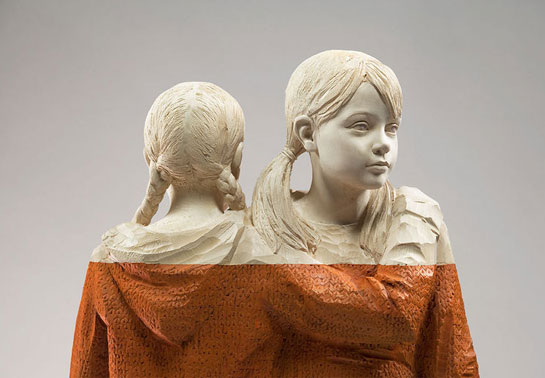
Willy Verginer, untitled, 2010
The stances of each girl reflect off one another and create a tension as the color stops only half way on the figures. They seem closely bonded, yet distant.

Bartolucci Sisters, untitled, 2010
Each curve sways through one another and forms a “water-like” flow that gives texture and balance throughout the image.

Michael T. Rea, Untitled, 2008
Every inch of this structure is filled with detail that creates realism, as though you could drive the tank around.

Krishna Khalsa, untitled, Oct. 2007
The way the sculpture builds up the wall in pieces gives the work a textured look that moves like a tornado.

Ashraf Gafer, “the Kiss,” 2008
The embrace is not clear although you can feel the presence of two figures touching one another. I like how there is only a hint of human figures connected in this moment.

Sam Hernandez, “Bini,” 2005
The structure seems completely organic in shape and texture except for the two cut out rectangles that seem to place a balance within the piece.

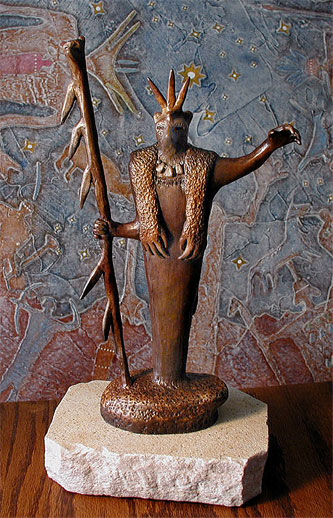
El Studio Granados, “Bear Spirit Shaman,” 2010
The figure is very spiritual because of the tall stance and mystical presence of a sort of higher being making its statement.

Andrew Frost, “Alice in Wonderland,” Not Dated
I love how big this sculpture is because it makes it seem as though it is a real place frozen in time. It brings mystery and wonder.

Geoffrey Gorman, untitled, May 30, 2009
This piece is affective by how the stance of the deer is like a natural position, as well as the figure being covered in a sort of line pattern that keeps the piece interesting.

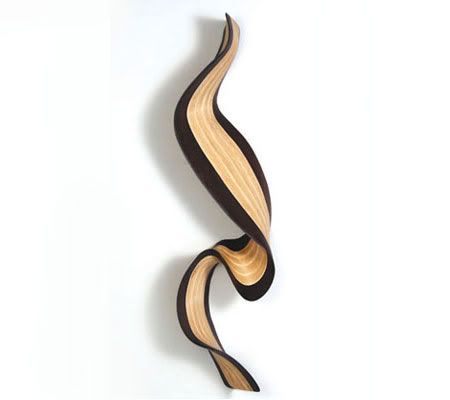
Kerry Vesper, Untited, 2008
The curves in this piece are beautifully executed with a smooth flow from top to bottom.

Kerry Vesper, untitled, 2008
By the sculpture being completely formed by swerves and lines that follow around the shape it allows the eye to move along the edges to create a unique rhythm.

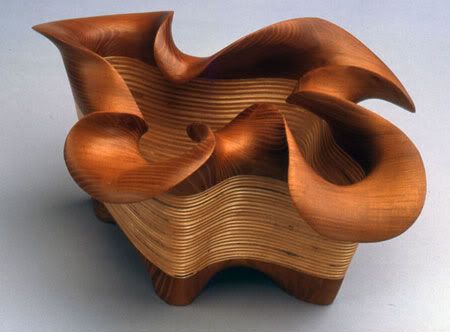
Ben Butler, untitled, 2010
The way the wood builds on layers gives the structure a nice shape that is almost illusionistic in design.

Paul Baden, Untitled, 2007
I like how the circular pattern echoes the shape of the figure and creates a balance throughout.  

Friday, October 15, 2010

Casting Designs

For the casting project, I wanted to create a clown with the mold. Either to paint one clown with detail or to make three and have the theme of "see no evil, hear no evil, and speak no evil."

Tuesday, October 12, 2010

Video Summary: Rachel Whiteread


Rachel Whiteread explains her fascinating sculpture, “Ghost.” She describes how the feeling to create such a piece came about. After her college years she had to live in a small space because of financial issues. This inspired her to re-create the feeling of living in such an environment and allow the viewers to experience the same sort of “claustrophobia.”
The sculpture was to be cast with plaster, which Whiteread constructed herself building up the plaster on the walls, with metal frame, and flicking the material to create texture and feel to the inside walls. The block was to resemble a room and contain a fireplace, window, “Mantle,” “Torso,” “Closet,” and “Shallow Breath.” The key elements to the piece are the objects that project an actual presence of a real living space. Although while preparing for this work, Whiteread says how she spent a good amount of time creating drawings that fit the composition she was searching for and making the perspective properly. Later, when beginning the process of strengthening the walls, she encountered problems with the dry walls flaking or breaking, which she had to keep repairing. The outcome of the piece is mysterious yet captivating by it's haunting presence and familiar objects contained within the structure. Whiteread certainly presented the idea she had in mind with clarity and formed an essence within the room that expressed her experiences from the past.  

“Sculpture in the Age of Doubt” By Thomas McEvilley 1999. Chapter 3 Summary:


During a time where there was a base for how art should be approached, one artist dared to go beyond the norm and take his work to another level. This man was Marcel Duchamp, the “artist of the century.” Duchamp began the change in the period of Modernism between 1911-1913, when he made a drastic change in his thought process. He rearranged his mind to think freely with no distinct base to guide him through his work. It started when he had his mental breakdown from the traumatic rejection that caused him to turn to a philosopher, who he thought knew how to live.
Duchamp lived a very dysfunctional life that caused him to have severe mental issues that changed his way of thinking. For a long period of time he fell in love with his sister, Suzanne. When she was married Duchamp finally snapped and completely broke everything he stood for as an artist. He gave up painting for a while and went into solitude with books about different philosophers, with one in particular who gave him a whole new outlook on life.
The philosopher Pyrrho of Elis influenced Duchamp by giving him a new approach to live life. His theory was to have no basis or certain structure that should tame natural freedom within the physical world. Pyrrho states that nothing truly exists, the world is an ever-changing essence, therefore came the question of uncertainty.
After Duchamp took in all he had learned, he became emotionally “numb.” He chose to feel nothing and wanted to prove that he could be an artist although he had no real emotions of his own. He created the “Readymade” pieces that were to simply be the object. He wanted to fool the audience as they discuss the aesthetic beauty of his pieces, when this is the opposite of what he wanted. He brought in the attitude of indifference, and did not believe in anything at all. These objects give the thought that they, perhaps, are the non-changing forms of reality. Although, when trying to reason with Duchamp he simply answers that he is indifferent and does not have a specific belief.
Duchamp has marked the beginning of the true Postmodernism era. As time progresses other artists have tried to recreate    Duchamp's work but only produce aesthetically pleasing pieces, they do not grasp the real concept behind his theory. Although they have been the only ones who have taken the closet approach to matching Duchamp, who wants rejection of style.

  1. What is sculpture today?
  2. Should style be something more then what appears?
  3. To be indifferent, should that mean loss of all emotion?